
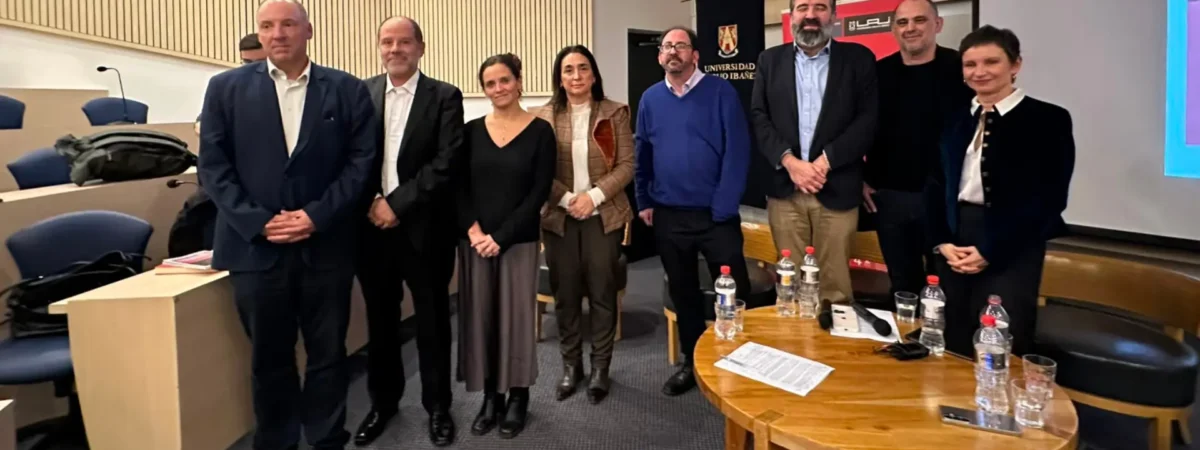
Academia, politics, and civil society gathered at the IAU to present CADLatam's book on organized crime, disinformation, and technology in Latin America. The panel's shared conclusion: the threats are converging, and the response requires stronger institutions, informed citizens, and regional cooperation.
Last Thursday, June 11, at the President Errázuriz Headquarters of the Adolfo Ibáñez University, we officially presented Besieged Democracies: Crime, Disinformation and Technology in Latin America, a collective work of the Center for Analysis for Democracy (CADLatam) written by Pablo Zeballos, Douglas Farah, Sascha Hannig and Pablo Matamoros, under the edition of Aldo Rojas.
The activity —organized in conjunction with the School of Communications and Journalism and the School of Government of the UAI, and the Konrad Adenauer Foundation— It brought together a diverse audience of academics, students, authorities, analysts, and communication and security professionals, confirming that the question that articulates the book touches a nerve in the current public debate: how do organized crime, disinformation, and technology affect Latin American democracies?
A fence that no longer allows for separate readings
The welcome address was given by Magdalena Browne, dean of the UAI School of Communications and Journalism, and Olaf Jacob, representative of the Konrad Adenauer Foundation in Chile, who highlighted the value of opening spaces for rigorous analysis of phenomena that are usually addressed in a fragmented or purely circumstantial way.
Aldo Rojas, director of CADLatam and editor of the volume, presented the book's structure: four complementary perspectives that examine how transnational organized crime, disinformation operations, and the strategic use of technology have ceased to be parallel threats and now operate as a converging siege on the region's democratic governance. Hence the title: democracies that do not collapse overnight, but are besieged—eroded in their territory, their public discourse, and their institutional trust.
The panel: hard diagnosis, institutional exit
The discussion brought together voices that rarely share a table. María José Naudon, dean of the UAI School of Government, contributed the institutional and public policy perspective; Carolina Tohá, former Minister of the Interior and Public Security, shared her experience confronting these phenomena from the front lines of government; Pablo Zeballos, an intelligence and organized crime specialist and researcher at CADLatam, described the expansion and sophistication of criminal economies in the continent; and Pablo Matamoros, executive director of CADLatam and professor in the UAI Master's Program in Political Communication and Public Affairs, addressed the informational dimension of the siege: disinformation, foreign influence operations, and the impact of artificial intelligence on democratic discourse. The discussion was moderated by Andrés Scherman, director of the UAI Master's Program in Political Communication and Public Affairs.
Three key ideas emerged from the exchange that summarize the spirit of the book and the debate:
1. Threats converge and feed off each other. Organized crime no longer just fights for territory: it fights for narratives, buys legitimacy, and exploits the very digital ecosystems where disinformation circulates. Analyzing them separately is to underestimate them.
2. Polarization is fertile ground for siege. Fractured societies with low institutional trust are more vulnerable to influence peddling, criminal capture, and technological manipulation. Defending democracy also requires rebuilding the public discourse.
3. The response is institutional, citizen-led, and regional. No country can face phenomena that are, by definition, transnational alone. The panel agreed on the need to strengthen state capacities, cultivate critical citizenship, and build effective regional cooperation in security, information integrity, and technological governance.
What's coming
Besieged democracies It is not a final destination, but a working platform. In the coming weeks, we will publish a series of articles on cadlatam.org that delve deeper into the book's chapters, its analytical frameworks, and its recommendations, along with opportunities for conversation with the authors.
We thank Adolfo Ibáñez University and the Konrad Adenauer Foundation for making this launch possible, and all those who joined us. Democracy is defended, first and foremost, by precisely understanding what threatens it. This book is our contribution to that task.
For inquiries about the book, presentation activities, or collaborations, please contact us through cadlatam.org.
Leave a Reply