
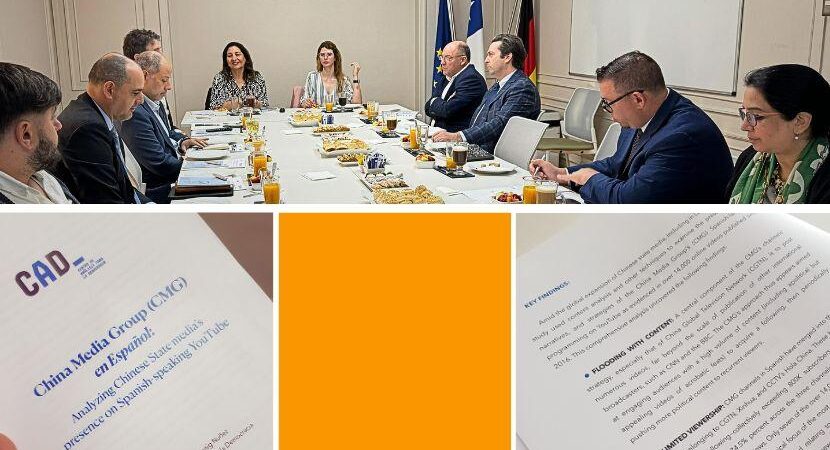
A study by the Center for Analysis for Democracy (CAD) in collaboration with Freedom House examined the behavior of Beijing's propaganda media in Spanish through more than 14,000 videos on YouTube. The analysis revealed that Chile is the country most mentioned by official Chinese channels in the region, with a predominant focus on bilateral cooperation, the SINOVAC vaccination campaign and the fight against the pandemic.
Key findings
Using scraping tools and statistical analysis, the study identified distinctive patterns in the three main channels of the Chinese media system in Spanish:
- Xinhua — 79,000 followers and over 31 million views. Of the 334 videos with more than 1,000 views, Chile is the most frequently mentioned country in the region. The predominant topics: the fight against the pandemic, vaccination campaigns, and cooperation between Chile and China.
- CGTN in Spanish — the channel with the greatest impact in the system. Publications related to Russia and other international conflicts garnered the most public attention, even though the channel focuses its efforts on promoting Beijing's foreign policy. The study identified that CGTN helped Russia amplify its narratives about the invasion of Ukraine.
- Hello China — the third channel analyzed focuses on sharing documentaries and dramas produced in the People's Republic of China.
The study also identified instances of the spread of disinformation, conspiracy theories, and falsehoods, particularly in relation to the COVID-19 pandemic. Additionally, Xinhua has collaborated with regional governments or ruling parties in Cuba, Venezuela and Mexico to amplify their messages, highlighting the close ties between Beijing and these nations.
Despite having over 800,000 subscribers combined, the vast majority of the videos (74,5%These channels received fewer than 500 views—a limited reach compared to the system's massive publishing effort. These channels publish more videos than the BBC, CNN, Deutsche Welle, or any national channel in Latin America.
A coordinated narrative strategy
«"According to our research, the propaganda mechanisms of the official media of the People's Republic of China act in a coordinated manner when generating different narratives. We had already identified them on networks like Twitter (X) and now on video channels like YouTube. A next step is to analyze what is happening on TikTok."»
Pablo Matamoros, Executive Director of CAD
«"The study confirms that these media outlets function more as propaganda and diplomatic tools than as news outlets. In the case of Chile, the SINOVAC vaccination campaign has been used as a success story to emphasize China's role in the region."»
Sascha Hannig Núñez, author of the study and co-founder of CAD
Hannig added: «"These channels publish more videos than the BBC, CNN, Deutsche Welle, or any national channel in Latin America. Although many of them are positive propaganda seeking to expand their soft power, more aggressive campaigns occasionally appear, attacking specific politicians or countries, or spreading conspiracies from Beijing. One risk is that there are no alternative channels to these narratives."»
risk assessment
The study underscores the importance of considering the risks associated with the spread of Chinese propaganda on YouTube. While Chinese channels on the platform have captured the attention of Chilean audiences, the authors emphasize the need to closely examine the potential for undue influence, disinformation, and amplification of government narratives.
The work is part of a line of research by the CAD on the media influence of the Chinese Communist Party in Latin America, cited in the report Beijing's Global Media Influence 2022 — Chile from Freedom House.
Authors: Sascha Hannig Núñez and Pablo Matamoros.
Study period: end of 2023 — published in February 2024.
Associated dissemination: Konrad-Adenauer-Stiftung — Chile Office.
Contact: pmatamoros@cadlatam.org · shannig@cadlatam.org
Leave a Reply